

Drawing Complex vs. Simple Subjects
—a Bobcat and a Butterfly Egg (Plus More Excitement!)

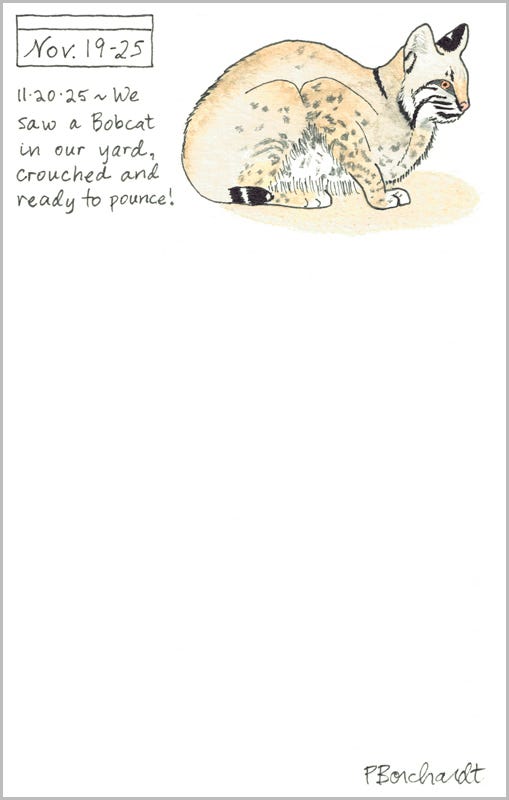
Hubby and I recently had the privilege of once again seeing a Bobcat in our yard! We had a great view, watching the Bobcat licking its fur, then crouching low to the ground getting ready to pounce, then s-t-r-e-t-c-h-i-n-g with its butt in the air (like yoga Down Dog pose, but in this case I think it was Down Cat pose) and finally s-t-r-e-t-c-h-i-n-g its front legs out so it seemed 10 miles long. So cool! 😍 After the Bobcat sauntered off I thought, “That is definitely going to be my Perpetual Journal entry for this week!”
My next thought was…gee…I’ve only drawn Bobcats twice before and they can be complicated to draw (especially with all those beautiful spots that I want to make sure I position correctly)!
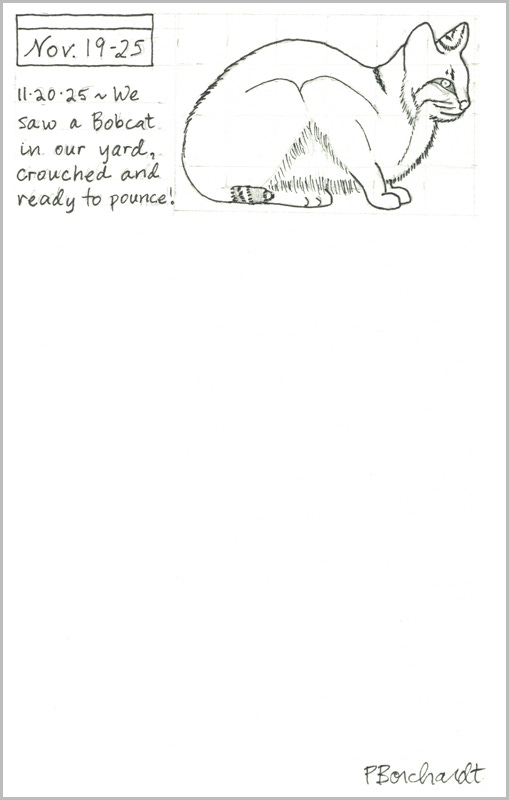
So when I started to draw our Bobcat friend, I utilized a tried-and-true technique that I find very helpful for complex subjects: using a grid. I overlaid a grid on my photo that I was using for reference, and then penciled in the same grid in my sketchbook. The grid allowed me to more easily see angles, scale, proportion, and exact placement of those beautiful spots.
Here’s my pen drawing of the Bobcat with my lightly penciled-in grid.
I added the spots before I erased my grid and then added watercolor. Here’s my final Perpetual Journal page:
Every. Single. Time. I see a Bobcat, I revel in its beauty and appreciate how fortunate I am to get to see them in my own yard!
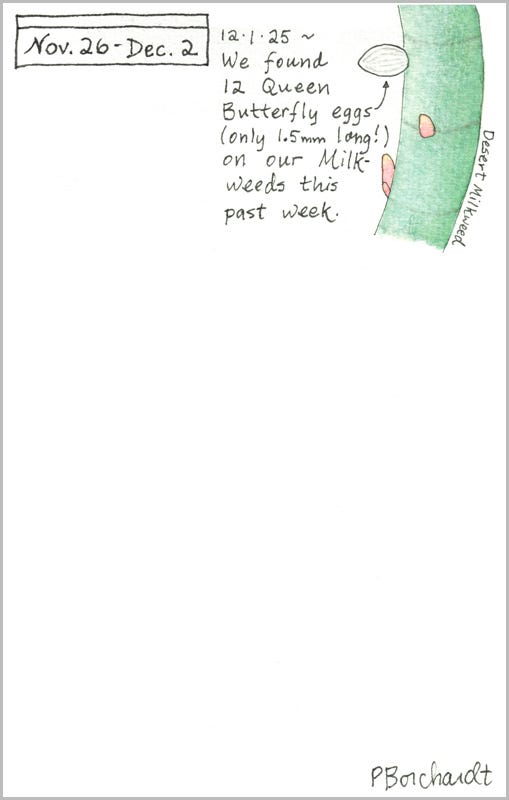
The next week, my PJ art was easy peasy to draw, in comparison: a Queen Butterfly egg on a Milkweed stem. My main consideration here was making sure the ratio of the length:width of the egg (a simple, pointy oval), and the ratio of the size of the egg to the Milkweed stem, were correct.
🥚More Egg-citement!
I’m excited to share another exciting nature event I witnessed in our yard! Last Thursday afternoon I was using a jeweler’s loupe to look at that same Queen Butterfly egg that I drew in my PJ, and the caterpillar started to hatch out of the egg at that exact moment! Wow! What timing! I just kept saying “Wow…WOW…WOW!” while I watched its tiny black head poke out first, followed by its almost transparent body. Wow!
With this fortuitous sighting I’ve now seen with my own eyeballs the entire Queen Butterfly life cycle: I’ve seen Queen Butterflies laying eggs, an egg hatching into a caterpillar, caterpillars turning into chrysalises, and butterflies eclosing from the chrysalises!
Here’s a photo I took the next day of a one-day-old Queen caterpillar—only 1.5mm in length, if that! Is this just cute as a button, or what?!!? 😍
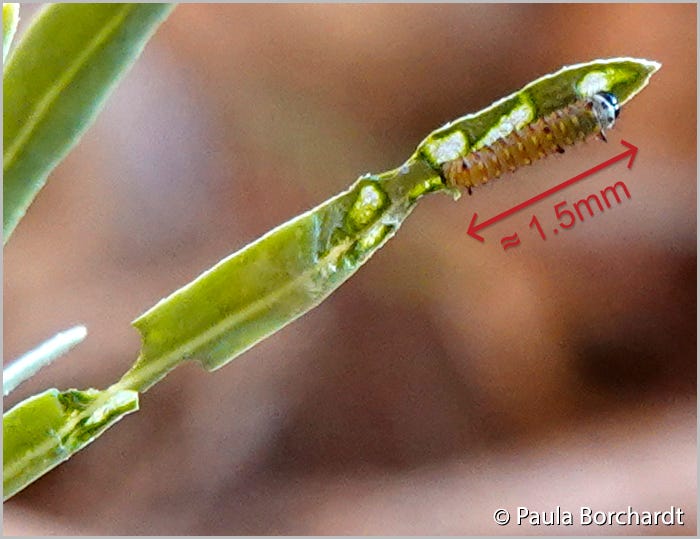
You can clearly see the parts of the Milkweed leaf the caterpillar has already munched, the caterpillar’s black head at the right, and its three sets of tubercles (pointy sense organs) showing that it’s a Queen, not a Monarch (which have only two sets of tubercles).
Even More Excitement!
But wait! Don’t go yet—I have even more excitement to share! This blog, and Hubby’s and my citizen science work, just got a nice shout-out from The Revelator in their article This Year in Conservation Science. Woo hoo! 🤗
~ ~ ~ ~ ~ ~ ~ ~ ~ ~
“The present moment is filled with joy and happiness. If you are attentive, you will see it.”
- Thich Nhat Hanh
Thank you for being here! I appreciate it. See you next week!
You can leave a comment or ask a question…
…and if you’ve enjoyed this, please share this post. Sharing makes the work involved in creating my posts even more worthwhile!
Delightful post & discoveries! I love the grid idea!
How I love learning more every week about your wonderful yard's occupants and surprise visits; this time a bobcat. I admire the art and journaling it. inspires here on Visual Storyteller. Applause is due, too, for the link to The Revelator--well done!